Book Now
+62 858-4738-7686Story
Inside Ijen: Life on the Volcano

Before most visitors reach the crater, Ijen’s sulphur miners are already at work. A glimpse into one of East Java’s most extraordinary ways of life.
While the World Sleeps
It is two in the morning. The mountain is wrapped in darkness, the air is cold, and the only sounds are footsteps on the rocky trail.
While most of East Java is still asleep, the sulphur miners of Mount Ijen are already climbing towards the crater. Some have made this journey thousands of times. They know every bend, every steep section, every loose stone beneath their feet.
As visitors make their way up the mountain hoping to catch a glimpse of the famous blue fire, the miners are heading somewhere very different.
Their working day is just beginning.
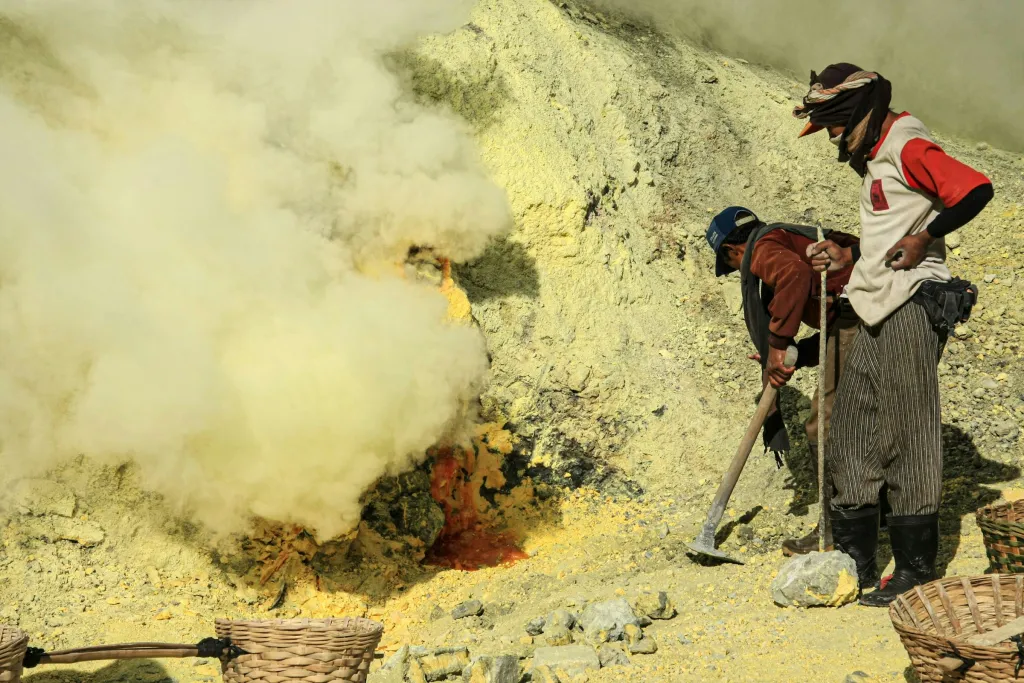
Deep inside the crater, thick clouds of volcanic gas drift across the rocks. Bright yellow sulphur forms around the pipes where hot gases emerge from the earth. Armed with simple metal tools, the miners break the hardened sulphur into pieces and carefully load it into two woven baskets.
There are no machines to carry the weight. No easy way back up.
Just the mountain, the baskets, and the long journey ahead.
The Heaviest Walk on Earth
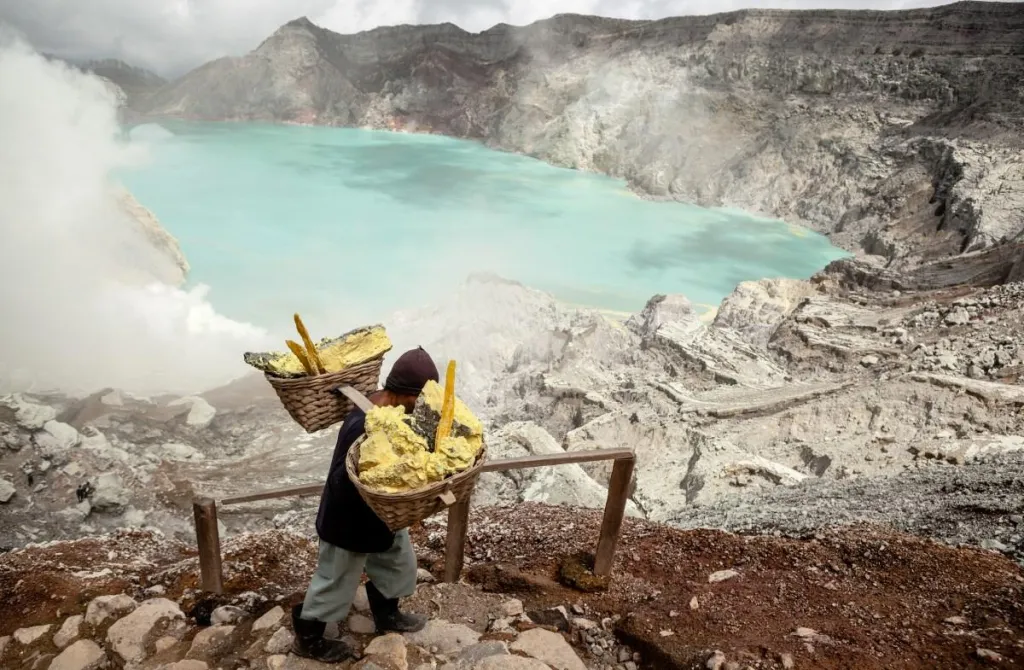
Imagine balancing 70 kilograms across your shoulders. Now imagine carrying it up a steep volcanic crater, along a narrow trail of loose rocks, with sulphurous gases swirling around you.
For Ijen’s miners, this is not an extraordinary challenge. It is their daily work.
Some loads weigh as much as 90 kilograms. The baskets hang from either end of a wooden pole, bending under the weight as the miners begin their climb.
Every few steps, a miner may stop to adjust his load. The wooden pole presses into his shoulder. The trail twists upwards, and the crater rim still seems impossibly far away.
Once they reach the top, another long descent awaits.
Along the way, visitors often step aside to let them pass. A miner might offer a smile, a greeting, or a few words before continuing down the mountain.
It is a brief encounter, but one that can stay with you long after you have forgotten the climb itself.
And at the end of the journey, the sulphur is weighed. Their earnings depend on how much they have managed to carry.
The Men Behind the Baskets
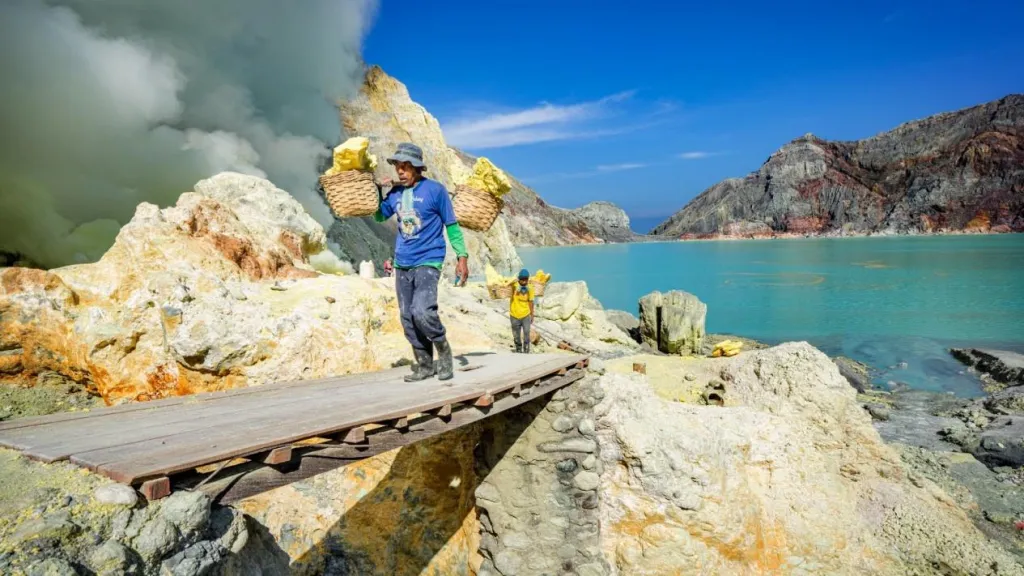
It would be easy to see the miners only through the lens of a camera: the brilliant yellow sulphur, the heavy baskets, the dramatic volcanic landscape.
But behind every load is a person.
A father working to support his children. A husband hoping to bring enough money home. A man who has spent years learning how to navigate one of the harshest working environments imaginable.
For many in the villages surrounding Ijen, mining is a way of life. Some follow paths once walked by their fathers or grandfathers. Others have taken up the work because it offers an important source of income.
Their strength is remarkable, but their work comes at a cost. The heavy loads place enormous strain on their bodies, while exposure to volcanic gases presents serious health risks.
Yet there are moments of ordinary human connection. Miners sharing a rest, exchanging a joke, or greeting familiar faces along the trail.
When the Mountain Turns Gold
Then, slowly, the darkness begins to lift.
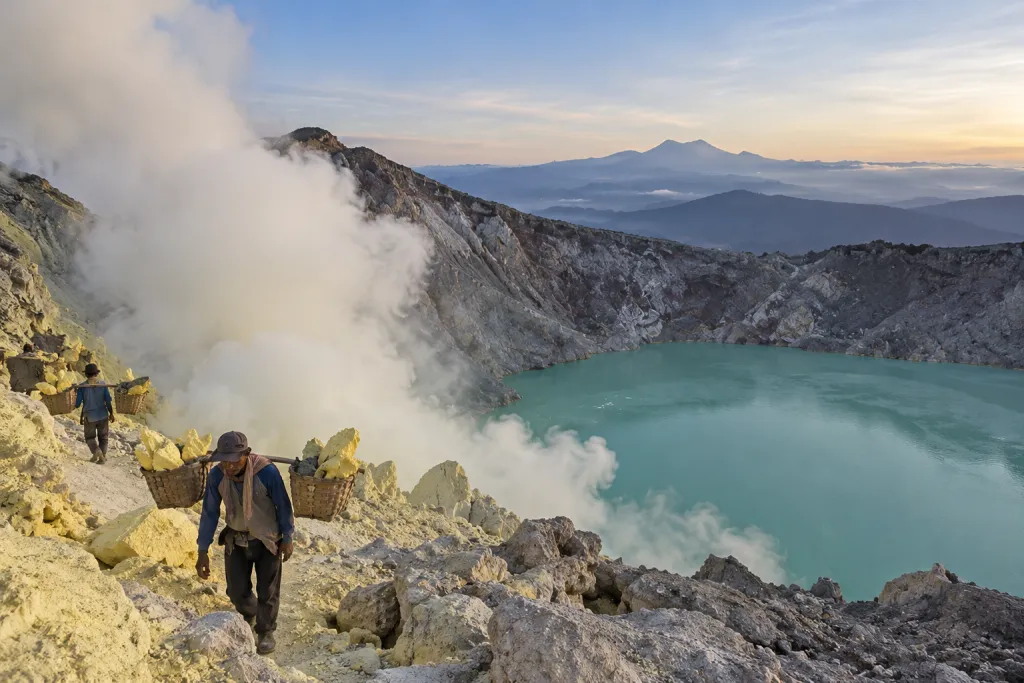
The first light of dawn reaches the crater walls. The enormous turquoise lake emerges from the shadows, its milky waters surrounded by rugged cliffs and rising steam.
For visitors, this is the moment they have been waiting for.
Cameras come out. People gather at the viewpoint. The mountain reveals itself in shades of gold, grey, and turquoise.
But look towards the trail, and another scene is unfolding.
A miner makes his way along the rocky path, his baskets full of yellow sulphur. Behind him lies one of Indonesia’s most extraordinary landscapes. Ahead of him, another difficult stretch of the journey.
Two completely different experiences, taking place on the same mountain, at the same moment.
For one person, it is the highlight of a holiday.
For another, it is the journey home from work.
The Story You Take Home
Mount Ijen is famous for its blue fire, its otherworldly crater lake, and its unforgettable sunrise.
But sometimes the most powerful memory is not the landscape itself.
It is the sound of footsteps on volcanic rock. The sight of a miner balancing an impossibly heavy load. A brief smile exchanged in the early morning light.
These are the moments that reveal another side of Ijen — one that cannot be captured by a photograph alone.
The volcano may be what brings you here, but the people who work on it may be what you remember most.
Because behind the beauty of Mount Ijen lies a human story just as extraordinary as the mountain itself.